
Unlocking Doctrine Through Questions: The Catechetical Method for Bible Study
The Catechetical Method uses a question-and-answer format to explore and teach biblical doctrine, drawing from the rich tradition of historic catechisms. By grounding each question and answer in Scripture, this method fosters clarity, reflection, and doctrinal depth.
Dan Burnfield
8/17/20254 min read
Introduction
Imagine a tool that transforms abstract theology into actionable truth—one question at a time. The Catechetical Method does exactly that. Rooted in ancient Christian practice (from the Greek katecheō, "to teach orally"), this approach uses structured questions and answers to clarify doctrine, reinforce biblical foundations, and disciple believers. Unlike casual reading, it demands active engagement, turning passive listeners into confident truth-holders.
Whether you’re wrestling with salvation, the Trinity, or God’s sovereignty, this method anchors your understanding in Scripture while equipping you to "always be prepared to give an answer" (1 Peter 3:15). Here’s how to harness its power.
What Is the Catechetical Method?
Definition:
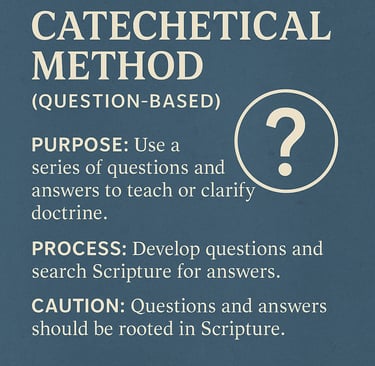
The Catechetical Method is a deductive Bible study approach that uses a question-and-answer format to systematically teach doctrine. Questions are crafted to target core theological truths, while answers are drawn directly from Scripture.
Historical Roots:
Early Church: New converts memorized creeds (e.g., the Apostles’ Creed) through catechism before baptism.
Reformation: Luther’s Small Catechism and Calvin’s Geneva Catechism used Q&A to combat ignorance and superstition.
Modern Use: The Westminster Shorter Catechism (1647) remains a gold standard, opening with: “What is the chief end of man? To glorify God and enjoy Him forever.”
Purpose:
Clarify Complex Truths: Breaks doctrine into digestible units (e.g., “What is sin?”).
Build Confidence: Empowers believers to articulate their faith.
Foster Accountability: Ideal for one-on-one discipleship or group study.
Why This Method Matters
1. Combats Shallow Faith
In an age of soundbite theology, the Catechetical Method forces depth. It replaces vague sentiments with precise biblical answers. For example:
Q: How can a holy God forgive sinners?
A: “He is faithful and just to forgive us our sins and to cleanse us from all unrighteousness” (1 John 1:9).
2. Enhances Scripture Memory
Questions create “mental hooks” for verses. Reciting answers reinforces retention better than passive reading.
3. Guards Against Error
By tethering every answer to Scripture, it prevents subjective interpretations. As the Westminster Confession warns: “Do not add to His words, lest He rebuke you” (Proverbs 30:6).
4. Equips for Evangelism
Structured Q&A prepares believers to respond to skeptics. Paul modeled this in Acts 17:2–3, “reasoning with them from the Scriptures.”
Step-by-Step: How to Practice the Catechetical Method
Step 1: Choose a Doctrine or Topic
Start with foundational themes:
Salvation (e.g., justification, sanctification)
God’s attributes (e.g., sovereignty, love)
Church practices (e.g., baptism, prayer)
Example Topic: The Doctrine of Salvation.
Step 2: Develop Biblical Questions
Craft questions that:
Are Rooted in Scripture: Avoid hypotheticals. Focus on what the Bible explicitly addresses.
Progress Logically: Move from broad to specific.
Sample Questions for Salvation:
What is sin?
What are the consequences of sin?
How does God save sinners?
What is grace?
How do we receive salvation?
Step 3: Search Scripture for Answers
For each question, compile answers using:
Direct Quotes: Let Scripture speak.
Cross-References: Show thematic unity.
Example for Question 3 (“How does God save sinners?”):
“For by grace you have been saved through faith” (Ephesians 2:8).
“Christ died for our sins” (1 Corinthians 15:3).
“He saved us... by the washing of regeneration” (Titus 3:5).
Step 4: Structure the Q&A Format
Organize answers concisely. Use this template:
Q: [Question]
A: [Scripture-backed answer]. Supporting verses: [List references].
Full Example:
Q: What is grace?
A: Grace is God’s unmerited favor toward sinners, granting salvation we don’t deserve. Supporting verses:
Step 5: Review for Balance and Clarity
Ensure answers:
Reflect the whole counsel of God (Acts 20:27).
Avoid overemphasizing one aspect of truth.
Cautions and Safeguards
1. Avoid Proof-Texting
Danger: Isolating verses to force an answer.
Solution: Read answers in context. For example, “Faith without works is dead” (James 2:26) must balance “Not by works” (Ephesians 2:9).
2. Resist Leading Questions
Danger: Framing questions to push an agenda (e.g., “Don’t you agree that baptism is optional?”).
Solution: Use neutral, Bible-centered questions (e.g., “What does the Bible teach about baptism?”).
3. Prioritize Scripture Over Tradition
Danger: Repeating denominational views without biblical support.
Solution: Base every answer on explicit or clearly derived Scripture.
4. Acknowledge Mystery
Some doctrines (e.g., the Trinity) transcend full comprehension. Answers should say, “Scripture teaches X, though we cannot fully grasp it.”
Practical Example: A Mini-Catechism on Prayer
Topic: The Nature and Power of Prayer
Q: Why pray?
A: To commune with God, express dependence, and align with His will.
Supporting: Matthew 6:9–13; Philippians 4:6–7.Q: Does God always answer prayer?
A: God answers according to His wisdom—sometimes “yes,” “no,” or “wait”—but He always responds.
Supporting: 1 John 5:14; Isaiah 55:8–9.Q: What is the role of faith in prayer?
A: Faith trusts God’s character, even when outcomes are unseen.
Supporting: Mark 11:24; Hebrews 11:1.
How to Create Your Own Catechism
1. Start with the Apostles’ Creed or Lord’s Prayer
These ancient summaries provide a theological framework. Build questions around their clauses (e.g., “What does ‘I believe in the Holy Spirit’ mean?”).
2. Use the SALIG Method for Questions
Specific: “What is justification?”
Actionable: “How do we receive the Holy Spirit?”
Logical: Progress from foundational to complex.
Integrated: Show how doctrines connect.
Grounded: Root every question in Scripture.
3. Test Your Catechism
Doctrinal Soundness: Share with a pastor or mature believer.
Clarity: Can a new believer understand it?
Completeness: Does it cover key aspects of the topic?
4. Practice Regularly
Personal Use: Memorize Q&As during daily devotions.
Group Study: Role-play “teacher” and “student.”
Family Discipleship: Teach children using simplified versions.
Why This Method Endures
Creates Theological Muscle Memory
Just as athletes drill fundamentals, catechism ingrains truth through repetition.Fosters Intergenerational Faith
From Luther’s Small Catechism for children to modern discipleship, it bridges age gaps.Unifies the Church
Shared Q&As transcend denominations, focusing on core orthodoxy.
“Catechesis is the ancient practice of knitting truth into the fabric of the soul—one question, one verse, one life at a time.”
Conclusion: Your Turn to Question, Learn, and Teach
The Catechetical Method isn’t about rote memorization—it’s about owning the faith. As you craft questions and mine Scripture for answers, you’ll discover doctrine isn’t dry; it’s the living Word that “revives the soul” (Psalm 19:7).
Start today:
Pick a doctrine (e.g., grace, prayer, the Trinity).
Draft 3–5 questions.
Hunt for answers in Scripture.
Share your Q&A with a friend—and watch truth ignite.
“The question is not if we will be catechized, but by whom. Let it be Scripture.”