
Unlocking Doctrinal Depth: The Systematic Summary Approach to Bible Study
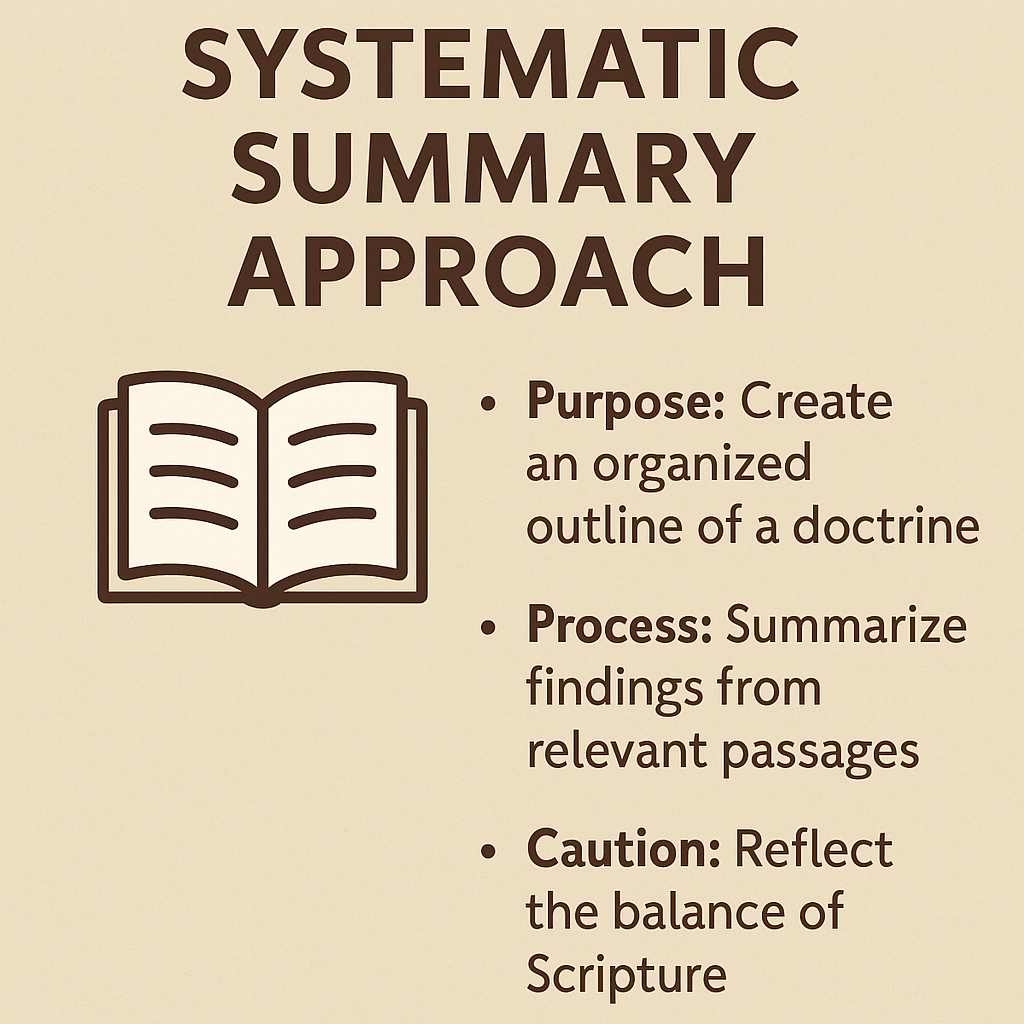
The Systematic Summary Approach is an academic method that defines key theological terms, gathers related Scriptures, and organizes findings into structured outlines. It seeks to present biblical doctrine as a unified whole, ensuring that conclusions reflect the full counsel of Scripture rather than isolated texts.
Dan Burnfield
8/10/20255 min read
Introduction
In an age of soundbite theology and fragmented biblical understanding, many Christians struggle to grasp the Bible’s unified teaching on core doctrines like grace, prayer, or the end times. Verses are often pulled out of context, leading to confusion or imbalance. The Systematic Summary Approach offers a solution: a rigorous, Scripture-saturated method for synthesizing the Bible’s full counsel into a coherent, life-changing framework.
This method isn’t about imposing human systems onto Scripture—it’s about letting Scripture shape our systems. As theologian J.I. Packer observed, “Theology is for doxology”—and this approach transforms abstract concepts into worship, grounding doctrine in God’s self-revelation.
What Is the Systematic Summary Approach?
Definition:
The Systematic Summary Approach is a deductive Bible study method focused on gathering all relevant passages on a doctrine or theme, analyzing them in context, and organizing them into a logical outline that reflects Scripture’s own structure and emphasis.
Purpose:
To move beyond isolated “favorite verses” and see the Bible’s unified voice.
To build doctrine from the ground up, ensuring every conclusion flows from the text.
To guard against theological imbalance (e.g., overemphasizing God’s love while neglecting His justice).
Why “Systematic”?
Unlike topical studies that might trace a single word, this method demands wrestling with the Bible’s full theological scope. For example:
Studying “salvation” requires synthesizing election (Ephesians 1:4), justification (Romans 3:24), sanctification (1 Thessalonians 4:3), and glorification (Romans 8:30).
Examining “prayer” integrates Jesus’ teaching (Matthew 6:9–13), apostolic practice (Acts 4:31), and Old Testament precedents (Psalm 50:15).
Why This Method Matters
1. Guards Against Imbalance
Human nature gravitates toward comfortable truths. The prosperity gospel cherry-picks promises of blessing but ignores suffering (John 16:33). Hyper-grace theology highlights forgiveness but downplays holiness (Romans 6:1–2). The Systematic Summary Approach forces us to confront all that Scripture says, preserving biblical tension.
2. Reveals Scripture’s Coherence
The Bible wasn’t written as a systematic theology textbook—yet its 66 books display remarkable unity. This method highlights how:
Old Testament sacrifices (Leviticus 4:35) point to Christ’s atonement (Hebrews 9:28).
Jesus’ resurrection fulfills Davidic covenant promises (Psalm 16:10; Acts 2:25–31).
3. Equips for Real-World Challenges
When life crumbles, clichés fail. But doctrine grounded in the whole Scripture sustains:
In suffering: A summary of God’s sovereignty (Romans 8:28) and compassion (Psalm 34:18) anchors the soul.
In evangelism: Understanding all the Bible says about sin and grace prevents reductionist presentations.
Step-by-Step Process
Step 1: Define Your Doctrine
Start with a clear focus. Examples:
Soteriology (salvation)
Ecclesiology (the church)
Eschatology (end times)
The attributes of God
Tip: Narrow broad topics. Instead of “prayer,” study “Jesus’ teaching on prayer” or “Paul’s prayer practices.”
Step 2: Gather All Relevant Passages
Use tools to ensure comprehensiveness:
Concordances (e.g., Strong’s Exhaustive Concordance) for word-based searches.
Topical Bibles (e.g., Nave’s Topical Bible) for thematic references.
Digital Tools (e.g., Logos Bible Software) to cross-reference translations and genres.
Crucial: Include all texts—even “difficult” ones. For example, a study on divine sovereignty must include both God’s election (Ephesians 1:4–5) and human responsibility (Philippians 2:12–13).
Step 3: Analyze Passages in Context
For each text:
Observe: Note the historical setting, genre, and audience.
Interpret: Determine the author’s intent.
Correlate: Compare with related passages (e.g., how James 2:24 on “faith and works” complements Romans 3:28).
Avoid “context jumping”—interpreting poetry like prophecy or vice versa.
Step 4: Organize Findings into a Logical Outline
Group passages into categories that reflect Scripture’s own structure. For example, a summary of salvation might outline:
The Problem: Human sin and separation from God (Romans 3:23; Isaiah 59:2).
God’s Initiative: Election and redemption planned in eternity (Ephesians 1:4–7).
Christ’s Work: Atonement through His life, death, and resurrection (Romans 5:8; 1 Corinthians 15:3–4).
The Response: Faith and repentance (Acts 20:21; Romans 10:9).
The Result: Justification, sanctification, and glorification (Romans 8:30; 1 Corinthians 1:30).
Key: Let Scripture’s emphasis guide your outline. If the Bible spends more time on God’s holiness than end-times chronology, your summary should too.
Step 5: Synthesize and Summarize
Distill your outline into a clear, concise statement of the doctrine. Example for prayer:
“Biblical prayer is God-centered communion, grounded in Christ’s mediation (Hebrews 4:14–16), dependent on the Spirit’s help (Romans 8:26), and marked by humility (Luke 18:9–14), persistence (Luke 11:5–13), and submission to God’s will (Matthew 6:10). Its purposes include worship, confession, thanksgiving, and supplication (Philippians 4:6), always aligning with God’s character and purposes (1 John 5:14).”
Cautions and Challenges
1. Avoid Proof-Texting
Danger: Stringing together verses to “prove” a preconceived idea.
Solution: Let each passage speak in its context. If a verse seems to contradict your thesis, dig deeper—don’t ignore it.
2. Respect Scripture’s Balance
Example: A summary of God’s love must include His wrath against sin (Romans 1:18; 1 John 4:8–10). Omitting either distorts the gospel.
3. Beware of Theological Bias
Danger: Reading your denomination’s tradition into the text.
Solution: Pray for the Spirit’s guidance (John 16:13) and consult diverse, trusted commentaries.
4. Acknowledge Mystery
Some doctrines (e.g., the Trinity) contain tensions that finite minds can’t fully resolve. It’s faithful to say, “Scripture affirms both truths; we hold them in tension.”
Practical Example: The Doctrine of Prayer
Step 1: Define
Focus: “The Nature and Practice of Prayer in the New Testament.”
Step 2: Gather Passages
Jesus’ teaching: Matthew 6:5–15; Luke 11:1–13; John 17.
Apostolic prayers: Ephesians 1:15–23; 3:14–21; Philippians 1:9–11.
Instructions: 1 Thessalonians 5:17; 1 Timothy 2:1–2; James 5:13–18.
Step 3: Analyze
Matthew 6:9–13: The Lord’s Prayer as a model of God-centeredness, not a magical incantation.
James 5:16: “Effective prayer” linked to righteousness, not eloquence.
Step 4: Outline
The Foundation: Prayer as Trinitarian communion (Ephesians 2:18).
The Posture: Humility (Luke 18:9–14), faith (Mark 11:24), and persistence (Luke 18:1–8).
The Content: Adoration, confession, thanksgiving, supplication (Philippians 4:6).
The Power: Dependent on Christ’s mediation (Hebrews 7:25) and the Spirit’s help (Romans 8:26).
Step 5: Summarize
“New Testament prayer is intimate dialogue with the Father, made possible by the Son and empowered by the Spirit. It begins in worship, flows from a repentant heart, and aligns with God’s will. It is both personal (Matthew 6:6) and communal (Acts 4:31), persistent in asking yet trusting in God’s wisdom (Luke 22:42).”
Tools for Deeper Study
Systematic Theologies:
Concise Theology by J.I. Packer (accessible).
Systematic Theology by Wayne Grudem (comprehensive).
Digital Resources:
Logos Bible Software (for cross-referencing and word studies).
BlueLetterBible.org (free access to lexicons and commentaries).
Community:
Study groups to test interpretations (Proverbs 27:17).
Conclusion: From Summary to Doxology
The Systematic Summary Approach isn’t academic gymnastics—it’s a pathway to awe. When we trace a doctrine like grace from Genesis to Revelation, we see:
Abraham’s justification by faith (Genesis 15:6)
David’s cry for mercy (Psalm 51:1)
Jesus’ gift of righteousness (Romans 5:17)
The saints’ eternal song (Revelation 5:9–10)
Try it yourself:
Pick a doctrine (e.g., “God’s faithfulness”).
Gather 10–15 key passages.
Outline what Scripture emphasizes.
Write a one-page summary.
As you do, you’ll discover what the psalmist knew: “The sum of your word is truth” (Psalm 119:160). And in that truth, you’ll find freedom, wisdom, and unshakable hope.
“Doctrine is the skeleton of faith; without it, the body of belief collapses. But when fleshed out by the Spirit, it becomes a living, breathing witness to God’s glory.”
Your Turn: Start with the doctrine of God’s love (John 3:16; Romans 5:8; 1 John 4:7–12). Build a systematic summary—and let it reshape your heart, worship, and witness.