
TEXT Method: Unlocking the Depths of Scripture Through Translation, Engagement, Examination, and Takeaway
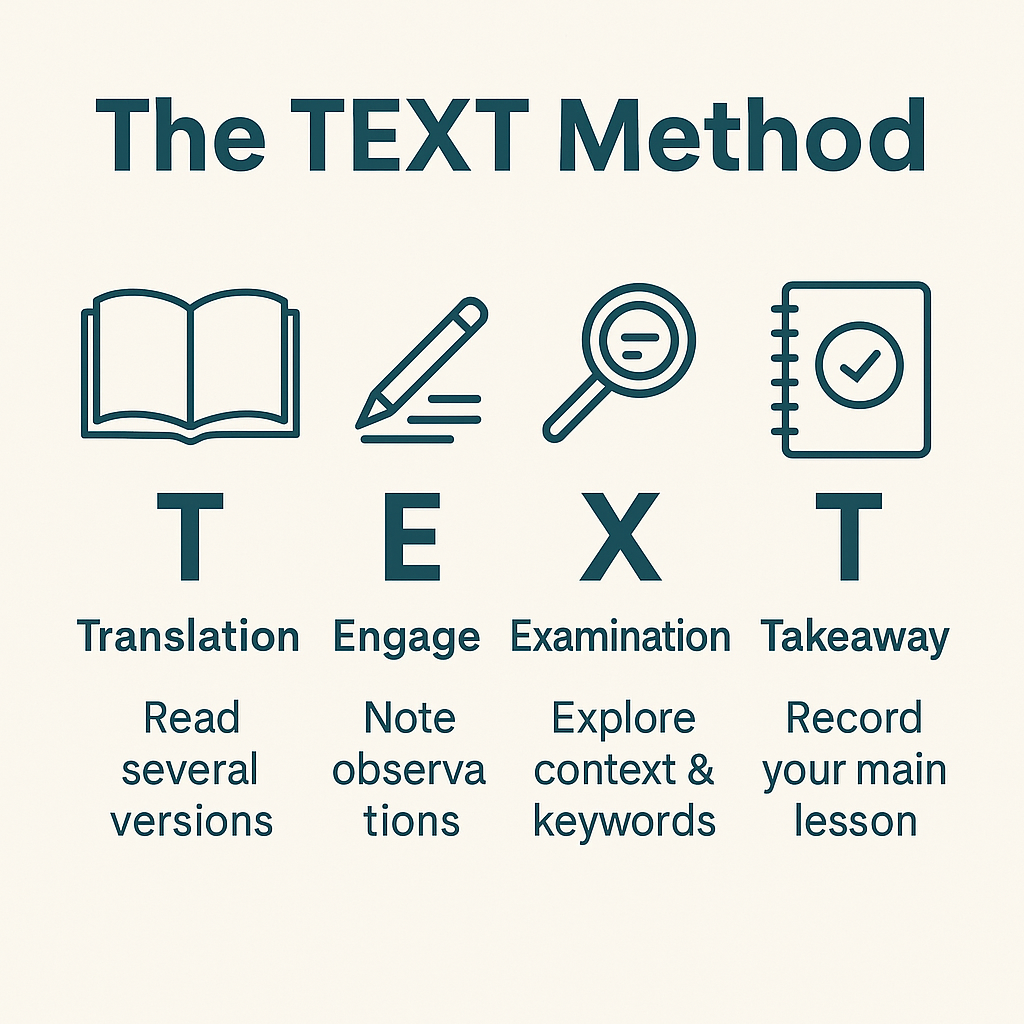
The TEXT Method is a practical Bible study approach that helps you slow down and engage deeply with Scripture. By moving through Translation, Engagement, Examination, and Takeaway, it guides you to understand the text more clearly and apply it personally.
Dan Burnfield
7/6/20256 min read
Introduction
In a world where information is abundant but true understanding is rare, the Bible stands as a unique and enduring source of wisdom, hope, and transformation. Yet, for many, the challenge is not just reading the Bible, but truly grasping its meaning and allowing it to shape life. The TEXT Method—Translation, Engagement, Examination, Takeaway—offers a practical, thorough, and deeply rewarding approach to Bible study. This method is especially valuable for those who want to go beyond surface reading, drawing out the riches of Scripture through careful, multi-layered exploration.
This blog post will guide you step by step through the TEXT Method, showing how each phase can help you encounter God’s Word with fresh eyes and an open heart.
Why the TEXT Method?
The TEXT Method is built on the conviction that Scripture is both accessible and profound. By intentionally moving through four distinct stages—Translation, Engagement, Examination, and Takeaway—you can slow down, see the text from new angles, and discover truths that might otherwise remain hidden. This method is especially useful for those who want to:
Compare translations and clarify meaning
Engage actively with the passage
Dig deep into context, keywords, and structure
Walk away with a clear, personal application
Whether you’re a beginner or a seasoned student, the TEXT Method can help you experience the Bible as living and active, relevant for every season of life.
Translation: See the Passage with Fresh Eyes
The first step in the TEXT Method is Translation—reading the passage in several different Bible translations. This is more than a technical exercise; it’s an invitation to see the text with fresh eyes and to notice nuances that a single translation might obscure.
How to Approach Translation:
Choose your passage (for example, Romans 12:1–2 or Psalm 23).
Read it in your primary Bible translation.
Read the same passage in at least two or three other translations (e.g., NIV, ESV, NLT, NASB, The Message).
Note any differences in wording, emphasis, or tone.
Why Multiple Translations?
Every translation is an act of interpretation. Some aim for word-for-word accuracy (literal), while others prioritize readability (dynamic equivalence). By comparing translations, you can:
Clarify ambiguous or difficult phrases
Notice repeated words or themes
See how translators handle idioms, metaphors, or theological terms
Example:
Romans 12:2 in the ESV reads, “Do not be conformed to this world, but be transformed by the renewal of your mind…” The NLT puts it, “Don’t copy the behavior and customs of this world, but let God transform you into a new person by changing the way you think.” The Message paraphrases, “Don’t become so well-adjusted to your culture that you fit into it without even thinking.”
Each version adds color and depth, helping you grasp the heart of the passage.
Engagement: Interact with the Text
After reading the passage in multiple translations, move to Engagement. This step is about active interaction—marking, noting, and asking questions as you read.
How to Engage:
Highlight or underline words and phrases that stand out.
Write down initial thoughts, questions, or emotions.
Note repeated words, contrasts, commands, or promises.
Ask: What surprises, confuses, or challenges me?
Engagement is not passive. It’s about wrestling with the text, letting it provoke curiosity and reflection. This is where you begin to move from reading to discovery.
Example:
In Psalm 23, you might notice the repeated use of “He”—“He makes me lie down… He leads me… He restores my soul.” You might underline “I shall not want,” “valley of the shadow of death,” or “my cup overflows.” Each phrase invites further thought and response.
Examination: Dig Deeper Into Context, Keywords, and Structure
With your engagement notes in hand, it’s time for Examination—the heart of in-depth Bible study. Here, you dig beneath the surface, exploring the passage’s background, structure, and key terms.
How to Examine:
Context: Where does this passage fit in the book? What comes before and after? Who is speaking, and to whom?
Keywords: Look up important words in a Bible dictionary or lexicon. What do they mean in the original language? Are there repeated or theologically significant terms?
Structure: Outline the passage. Is there a logical flow, a list, a contrast, or a progression?
Genre: Is this poetry, narrative, prophecy, or epistle? How does genre affect meaning?
Historical/Cultural Background: What was happening when this was written? Are there customs, places, or events that need clarification?
Example:
In Romans 12:1–2, “renewal of your mind” is a key phrase. A word study might reveal that “renewal” (Greek: anakainosis) implies a complete renovation, not just a minor adjustment. The context—Paul’s call to present your bodies as a living sacrifice—connects to Old Testament sacrificial imagery, deepening your understanding of what true worship means.
Takeaway: Write Down Your Main Lesson or Application
The final step is Takeaway. After reading, engaging, and examining, pause to distill what God is saying to you through this passage. This is where you move from study to transformation.
How to Find Your Takeaway:
Summarize the main point of the passage in one or two sentences.
Ask, “What is God calling me to believe, feel, or do in response?”
Write down a specific application—a change in attitude, a step of obedience, a truth to remember.
Consider sharing your takeaway with a friend or group for encouragement and accountability.
Example:
From Romans 12:1–2, your takeaway might be: “God calls me to surrender every part of my life to Him, letting Him transform my thinking so I become more like Christ. Today, I will intentionally offer my plans and anxieties to God in prayer, trusting Him to renew my mind.”
The TEXT Method in Practice: A Step-by-Step Example
Let’s walk through the TEXT Method with a sample passage: Philippians 4:6–7.
1. Translation:
Read in ESV, NLT, and The Message.
ESV: “Do not be anxious about anything, but in everything by prayer and supplication with thanksgiving let your requests be made known to God.”
NLT: “Don’t worry about anything; instead, pray about everything. Tell God what you need, and thank him for all he has done.”
The Message: “Don’t fret or worry. Instead of worrying, pray. Let petitions and praises shape your worries into prayers, letting God know your concerns.”
2. Engagement:
Highlight “do not be anxious,” “prayer and supplication,” “with thanksgiving,” “peace of God.”
Note: The command is not just “don’t worry,” but “replace worry with prayer and gratitude.”
3. Examination:
Context: Paul is writing from prison, encouraging believers to rejoice and trust God.
Keywords: “Supplication” means earnest, humble request. “Peace” (Greek: eirene) is not just the absence of conflict but wholeness and well-being.
Structure: The passage moves from command (don’t worry) to action (pray, give thanks) to promise (God’s peace will guard you).
Genre: Epistle—direct instruction to believers.
4. Takeaway:
Main lesson: When worry rises, God invites me to pray with gratitude, trusting Him to give peace beyond understanding.
Application: Today, when I feel anxious, I will pause to pray and thank God for His faithfulness.
Why the TEXT Method Works
It slows you down. Multiple translations and careful examination prevent rushed or shallow reading.
It encourages curiosity. Engagement and examination foster a sense of discovery.
It grounds application in context. You’re less likely to misinterpret or misapply Scripture.
It leads to transformation. The Takeaway step ensures you leave with a clear, actionable lesson.
Tips for Using the TEXT Method
Use digital tools. Bible apps and websites make it easy to compare translations and look up original words.
Keep a journal. Record your TEXT process for future reflection and growth.
Be patient. Deep study takes time but yields rich rewards.
Pray throughout. Ask the Holy Spirit to illuminate, convict, and encourage you at every step.
Common Challenges and How to Overcome Them
“I don’t have time for all four steps.”
Even if you can’t do every step daily, try the full TEXT Method once or twice a week for deeper study.
“I get lost in the details.”
Remember, the goal is not to master every fact, but to encounter God and apply His truth.
“I’m not a scholar.”
The TEXT Method is for everyone. Use what resources you have, and focus on honest engagement.
Conclusion: Let the TEXT Method Transform Your Bible Study
The TEXT Method—Translation, Engagement, Examination, Takeaway—is more than a technique; it’s a pathway to deeper relationship with God through His Word. By seeing the text from multiple angles, wrestling with its meaning, and applying it to your life, you open yourself to the transforming work of the Holy Spirit.
If you’re longing for Bible study that is both accessible and profound, give the TEXT Method a try. Open your Bible, open your mind, and let God speak to you in new and powerful ways.
Start today:
Choose a passage—perhaps Psalm 1, John 15, or Ephesians 2. Walk through the TEXT steps. See what God will reveal as you read, engage, examine, and take away His truth for your life.
Let your Bible study move from routine to revelation—one TEXT at a time.