
Harvesting Wisdom: How to REAP the Riches of Scripture
In today’s busy world, it’s easy to read the Bible out of routine instead of seeking a real encounter with God. The REAP Method—Read, Examine, Apply, Pray—offers a clear and meaningful way to engage Scripture so that it truly shapes your heart and life.
Dan Burnfield
6/29/20255 min read
Introduction
In the fast-paced world we live in, it’s easy to treat Bible reading as a task to check off rather than a life-giving encounter with God. Yet, the Scriptures invite us into a deeper experience—a transformative journey where God’s Word shapes our thoughts, attitudes, and actions. The REAP Method (Read, Examine, Apply, Pray) is a simple, practical, and deeply effective way to move beyond surface reading and allow the Bible to take root in our hearts.
This blog post will walk you through the REAP Method step by step, offering practical tips, examples, and encouragement for anyone seeking to engage Scripture with purpose and expectation.
What Is the REAP Method?
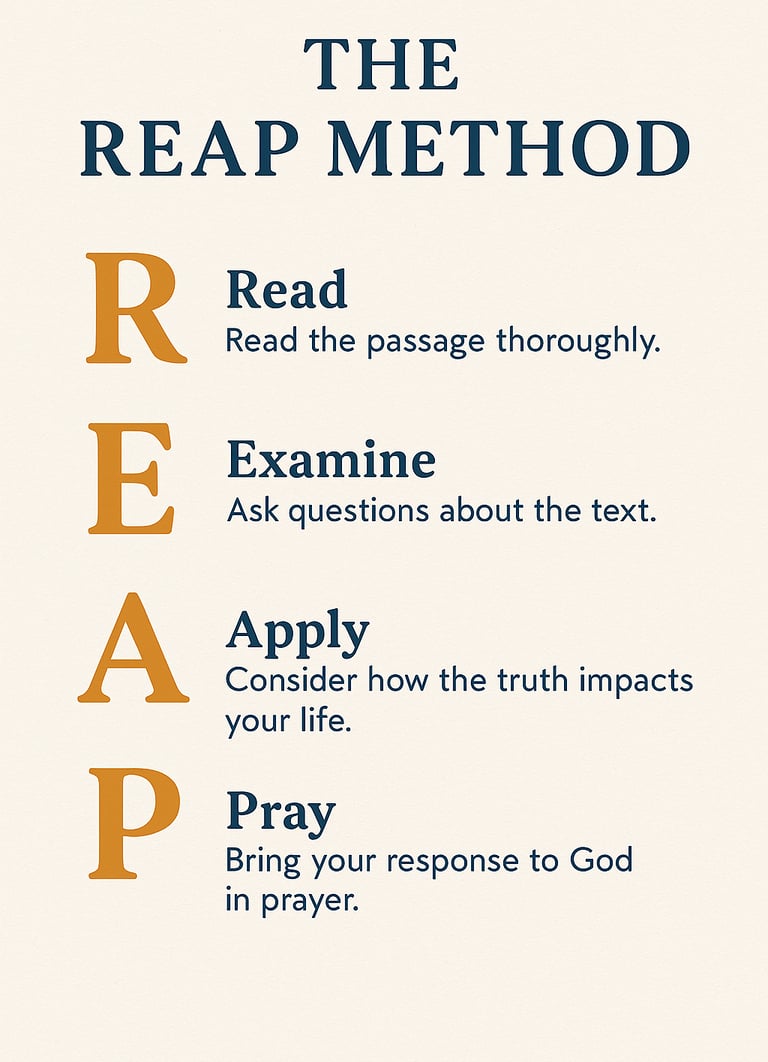
The REAP Method is an acronym for four essential steps:
Read: Read the passage thoroughly.
Examine: Ask questions about the text.
Apply: Consider how the truth impacts your life.
Pray: Bring your response to God in prayer.
This approach is accessible for beginners and valuable for seasoned believers. It helps you slow down, dig deeper, and respond to God’s Word in a way that leads to genuine transformation.
Step 1: Read – Immerse Yourself in the Passage
The first step is to Read the passage thoroughly. This means more than a quick glance or a hurried skim. Instead, approach the text with intentionality and openness.
How to Read Effectively:
Choose a manageable passage (4–10 verses, a short psalm, or a narrative).
Read it slowly, perhaps aloud, to capture the flow and feeling.
Read the passage multiple times. Each reading can reveal new details or insights.
Pay attention to words or phrases that stand out, repeat, or surprise you.
Tips:
Begin with prayer, asking God to open your heart and mind (Psalm 119:18).
Read with a pen or highlighter in hand to mark key words or ideas.
Don’t rush. Let the words sink in and invite the Holy Spirit to speak.
Example:
If you’re reading James 1:19–21, slow down and notice the sequence: “quick to hear, slow to speak, slow to anger.” Observe the connection between hearing God’s Word and living it out.
Step 2: Examine – Ask Questions and Dig Deeper
After reading, move to Examine. This step is about observation and curiosity. Good Bible study starts with good questions.
Questions to Ask:
Who is speaking, and to whom?
What is happening in the passage?
Are there commands, promises, warnings, or examples?
What words or ideas are repeated?
What is the context—what comes before and after?
What surprises, confuses, or challenges you?
How to Examine:
Write down your observations and questions.
Look for patterns, contrasts, and cause-and-effect relationships.
Use cross-references or a study Bible for clarification, but focus first on the text itself.
Example:
In James 1:19–21, you might ask:
Why does James emphasize being “quick to hear” and “slow to speak”?
How does anger relate to receiving God’s Word?
What does it mean to “receive with meekness the implanted word”?
Why Examine?
Examining the text helps you move beyond assumptions and see what is actually there. It guards against reading your own ideas into Scripture and opens you up to what God is truly saying.
Step 3: Apply – Bring the Truth Into Your Life
Now it’s time to Apply what you’ve learned. Application is where the Bible moves from information to transformation.
How to Apply:
Ask, “How does this truth impact my life today?”
Is there a command to obey, a promise to claim, a sin to confess, or an example to follow?
How does this passage challenge, encourage, or correct me?
Be specific—think about attitudes, actions, relationships, and decisions.
Tips for Application:
Write down one concrete way you will put the passage into practice.
Consider sharing your application with a friend or accountability partner.
Remember, application is not about perfection but about progress and obedience.
Example:
From James 1:19–21, you might apply: “Today, I will listen more and speak less in my conversations, especially when I feel frustrated. I will ask God to help me control my anger and receive His Word with humility.”
Why Apply?
Application is the bridge between knowing and living. As James says, “Be doers of the word, and not hearers only, deceiving yourselves” (James 1:22).
Step 4: Pray – Respond to God
The final step is to Pray. Bible study is not just an intellectual exercise—it’s a conversation with God. Prayer is where you bring your response, your questions, your gratitude, and your needs before Him.
How to Pray:
Thank God for what He has shown you.
Confess areas where you fall short or need help.
Ask for strength, wisdom, and courage to live out what you’ve learned.
Pray for others who may need to hear or apply the same truth.
Example Prayer:
“Lord, thank You for Your Word. Help me to be quick to listen and slow to speak. Give me a gentle spirit and the humility to receive Your truth. Change my heart and help me to live for You today.”
Why Pray?
Prayer seals the truth in your heart and invites the Holy Spirit to empower you for change. It turns Bible study from a duty into a relationship.
The REAP Method in Action: A Walkthrough
Let’s walk through the REAP Method with a familiar passage—Philippians 4:6–7:
“Do not be anxious about anything, but in everything by prayer and supplication with thanksgiving let your requests be made known to God. And the peace of God, which surpasses all understanding, will guard your hearts and your minds in Christ Jesus.”
Read:
Slowly read the verses several times, noticing the flow from command to promise.
Examine:
Who is speaking? Paul, writing to the Philippians.
What is the command? “Do not be anxious about anything.”
What is the solution? “In everything by prayer and supplication with thanksgiving let your requests be made known to God.”
What is the promise? “The peace of God… will guard your hearts and your minds.”
Apply:
“I will bring my worries about my job to God in prayer, thanking Him for His past faithfulness. When anxiety rises, I’ll remind myself of God’s promise to guard my heart and mind.”
Pray:
“Lord, I give You my worries today. Thank You for Your promise of peace. Help me to trust You and rest in Your care.”
Why the REAP Method Works
It’s simple and repeatable. Anyone can use it, anywhere.
It’s flexible. Works for a single verse or a whole chapter.
It engages both heart and mind. You read, ask, apply, and pray.
It’s transformative. Moves you from reading to living God’s Word.
Tips for Getting the Most Out of REAP
Be consistent. Set aside regular time for study.
Be honest. Write down real questions and struggles.
Be prayerful. Ask the Holy Spirit to guide you.
Be patient. Growth is a process, not an event.
Be communal. Share your REAP journey with others for encouragement and accountability.
Common Challenges and How to Overcome Them
“I don’t know what to ask.”
Start with basic questions: Who, what, where, when, why, and how.
“I get distracted.”
Find a quiet place, silence your phone, and ask God to help you focus.
“I don’t see immediate results.”
Remember, Bible study is like planting seeds. Fruit comes with time and faithfulness.
“I’m not a good writer.”
Bullet points or short phrases are fine. The goal is engagement, not eloquence.
The REAP Method and Spiritual Growth
The REAP Method is more than a technique—it’s an invitation to encounter God in His Word. As you read, examine, apply, and pray, you will:
Grow in biblical understanding.
Develop habits of prayer and obedience.
Experience God’s guidance and comfort in daily life.
See real change in your attitudes, relationships, and priorities.
The Bible promises that God’s Word is “living and active” (Hebrews 4:12). The REAP Method is a way to experience that living power for yourself.
Conclusion: Start REAPing Today
If you’re looking for a Bible study method that is simple, practical, and transformative, try the REAP Method. Open your Bible, open your heart, and let God speak. As you read, examine, apply, and pray, you’ll discover that God’s Word is not just something to be studied—it’s a living voice that calls you to know, trust, and follow Him.
Try it now:
Pick a short passage—maybe Psalm 23, John 15:1–8, or Romans 12:1–2. Walk through the REAP steps. See what God will do as you read, examine, apply, and pray.
Let the journey begin!